The Mime: When Keeping the Peace Creates False Harmony

Most people don’t enjoy conflict—but for leaders running the Mime Faulty Program, conflict doesn’t just feel uncomfortable; it feels threatening. Even minor disagreements can trigger a deep need to stabilize, smooth over, or silence themselves to maintain peace. What others might experience as a healthy debate feels risky to a Mime.

Our research shows that the Mime program shows up in 20 percent of leaders, keeping them trapped in the Stuckness Zone™. While it may resemble the People-Pleaser on the surface, the underlying motivation is different: Mime leaders fear disharmony, not disapproval.

This article is part of our Faulty Programs series. If you’re new here, start with our opener—“Why Leaders Get Stuck: The Stuckness Zone™ and Faulty Programs.” It lays the groundwork for what Faulty Programs are, how they form, and why upgrading them is essential for future-ready leadership.

How the Mime Faulty Program Shows Up

For Mime leaders, discord—even small amounts—creates internal instability. Their nervous system quickly associates conflict or tension with emotional danger.

It can sound or look like:

  • “Any conflict is bad.”
  • “Relationships can’t recover if there’s conflict.”
  • “It’s my job to keep the peace.”
  • “I can’t handle conflict—I need to stabilize it.”

Behaviorally, Mime tendencies often show up through:

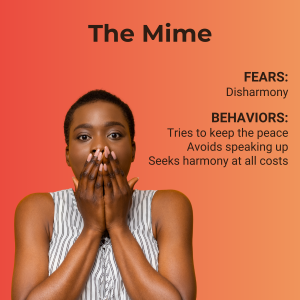
  • Avoiding speaking up if it might create tension
  • Staying silent when clarity is needed
  • Smoothing over or mediating conflict between others.
  • Stepping in to “fix” situations rather than letting others work through disagreements

While this can produce an appearance of harmony, it often results in artificial peace and hidden frustration.

The Fears Driving the Mime Program

Unlike the People-Pleaser’s fear of rejection, the Mime is driven by a fear of disharmony. Conflict feels inherently destabilizing.

Foundational beliefs often include:

  • Conflict is inherently negative.
  • If tension arises, something is wrong.
  • It’s my responsibility to prevent or fix discord.
  • Conflict ruins relationships.

When the Mime is active, the internal head trash sounds like:

  • “If I speak up, this might escalate.”
  • “It’s safer to stay quiet.”
  • “I need to keep everyone calm.”
  • “Stability depends on me.”

These beliefs are usually formed early in life, often in environments where conflict felt threatening or unpredictable. As adults, leaders continue performing the role of “peacekeeper,” even when it inhibits communication and effectiveness.

The Costs of the Mime Faulty Program

For Leaders
Over time, the Mime pattern erodes clarity, confidence, and well-being.
Common costs include:

  • Withholding valuable insights or concerns
  • Anxiety around emotionally charged conversations
  • Avoidance of important feedback or boundary-setting
  • Accumulated resentment from over-functioning
  • Feeling responsible for others’ emotions

For Organizations
Mime-led environments often appear harmonious on the surface, but underneath:

  • Communication becomes unclear or incomplete
  • Issues remain unresolved
  • Psychological safety erodes
  • Accountability weakens
  • Teams fall into dangerous silence and false harmony

This is significant because psychological safety is the top predictor of high-performing teams. When leaders avoid conflict, teams learn to do the same—holding back ideas, concerns, and conversations needed for innovation and performance.

📊 Want to dig deeper? Download our free research paper, Future-Proofing Leadership: What It Takes to Thrive Amidst Change and Disruption, to explore the findings from our study of 250 leaders across industries.

Where Leaders Get Stuck (Our Data)

Our analysis found that leaders running the Mime program struggle most in four adaptive leadership areas—each of which is fundamental for psychological safety and effective collaboration:

  1. Growth Feedback (41%) Most leaders running the Mime program actively want to get better at having growth-feedback conversations, but are quietly working against themselves. It makes sense because in any conversation with the possibility of difficult feedback, there is a potential risk for upsetting someone and creating discord or conflict.

  2. Speaking Up (36%) The next most common aspect of communication where the Mime finds leaders in the Stuckness Zone is speaking up with confidence and clarity. Our analysis found that 36 percent of leaders want to be better at speaking up in meetings, sharing their ideas, and contributing to conversations. Instead, they hold themselves back because their head trash tells them not to rock the boat. In these instances, the Mime tells them they risk upsetting the group or derailing an agenda if they speak up. For these leaders, withholding their contributions feels safer, even if they have ideas that could add value to a conversation or process. If these leaders are directly asked for their input, they often say they have nothing to add.

  3. Delegating (29%) A key aspect of leadership is delegating effectively and responsibly. However, 29 percent of the leaders in our study running the Mime program struggle with delegation. Leaders fear that people will be upset if they ask them to do things, or that doing so will add to their stress and burden. So they take on too much themselves to avoid any potential disharmony, then end up feeling greater stress and even resentment.

  4. Fostering Accountability (24%) Nearly one quarter (24 percent) of leaders running the Mime program want to get better at setting and aligning with clear goals and expectations and fostering greater accountability to meet those objectives. But fear of the disharmony that could result from accountability-related conversations gets in their way. They will either avoid them altogether, take on work themselves, or be too vague to be helpful. Then they frequently become frustrated or resentful, but will rarely say anything because they’re too focused on maintaining harmony. All the while, their well-being and effectiveness are quietly eroded.

Unlike any other faulty program, 100 percent of leaders running the Mime want to get better at some aspect of communication. And while these leaders want to improve communication, their programming leads them to believe that conflict is too risky to engage with directly.

Why We Get in Our Own Way

Mime programming often originates in early experiences where conflict felt overwhelming, unpredictable, or unsafe. Many leaders grew up in family systems where:

  • Conflict led to negative consequences
  • Emotional volatility required vigilance.
  • Staying quiet felt like the safest path
  • Stability depended on their managing others’ emotions.

As adults, they subconsciously replay these patterns—shying away from conflict, absorbing responsibility, and creating peace externally while experiencing internal stress.

Breaking Free: The Upgrade Process

Upgrading the Mime isn’t about becoming confrontational. It’s about shifting from external peacekeeping to internal peace-building—so you can participate fully, communicate clearly, and lead with courage.

1. Name It
Start by noticing when your Mime voice shows up:

“I’m not listening to your crap today, Mime. I’m not ten years old, and it’s not my job to protect everyone from conflict.”
Naming creates distance and interrupts the automatic pattern.

2. Own It
Map your personal expression and origin.

Expression:
Identify how the Mime shows up for you:

  • What thoughts fuel your self-silencing?
  • What situations activate your peacekeeping reflex?
  • How does this affect your communication and behavior?

Origin:
List 3–5 early experiences that led you to conclude that conflict is bad, you need to avoid it, and/or be the peacekeeper, or your safety requires that you stabilize situations where conflict is present. These insights reveal how your brain reacts to past experiences—not to present-day reality.

Acknowledge it with compassion:

“This program kept me safe growing up—but it’s not serving me now.”

3. Challenge It (Upgrade)
Replace the head trash with grounded, empowering statements:

Run micro-experiments.

Collect data that slowly disproves the lies the Mime has sold you. Start small and test the belief that disharmony is disastrous:

  • Gather feedback: Ask people who know you well the following question: “What is it like for you to be around me when I’m trying to keep the peace or avoiding speaking up?” It will likely sting – and that’s the point. When you hear that people likely want you to speak up, set boundaries, or stop trying to keep everyone happy, it will likely cause a moment of pause the next time you’re over-focused on trying to keep the peace.

  • Practice micro-bravery: Have one small, direct growth-feedback conversation using the motto “Clear is kind.” Let others work through conflict instead of jumping in to stabilize. Speak up once in a meeting where you would generally stay silent. Or delegate a task you’ve been holding to “avoid adding stress.”

  • Focus on inner peace: Shift from focusing on avoiding disharmony around you to actively nurturing harmony within yourself to find greater calm and clarity.

Each experiment chips away at the faulty narrative that conflict ruins relationships, proving that clarity and candor build stronger teams.

Steps You Can Take 

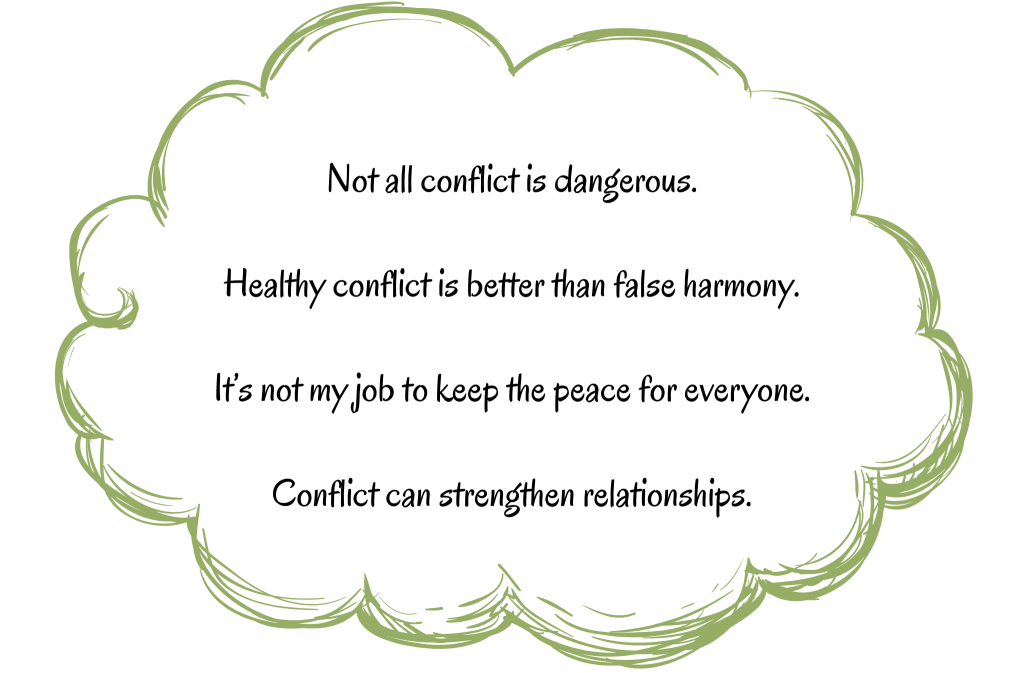
Say aloud: “Healthy conflict is more effective than artificial harmony.”

Prepare and initiate one clarifying conversation you’ve been avoiding.

Pause before intervening in others’ disagreements.

Share one idea or concern earlier in a meeting.

Visualize your blueprint—who you are without the Mime driving your leadership.

These small steps create momentum toward authentic, courageous communication.

Moving Beyond the Mime

Leaders who upgrade the Mime consistently experience a powerful shift. They stop trying to create peace around them and start cultivating peace within themselves.

When leaders stop self-silencing, they:

  • Communicate with more calm and clarity
  • Reduce unnecessary anxiety
  • Strengthen relationships through authenticity, not avoidance.
  • Build teams with real—not artificial—psychological safety.

At Salveo Partners, our Courageous Leadership Program helps leaders identify Faulty Programs like the Mime, rewrite self-limiting stories, and build the habits required for sustainable, human-centered leadership.

What’s Next in This Series

This article is part of our ongoing series unpacking the Faulty Programs that keep leaders stuck in the Stuckness Zone™.

Our aim is simple: normalize the messiness of being human, expose the invisible patterns holding leaders back, and provide actionable paths to help you—and your organization—thrive in a disruptive world.

Next up: The Martyr—why leaders over-carry and over-give, and how to shift from self-sacrifice to shared ownership and healthy boundaries.

Stay HUMAN. Stay connected. Stay safe. Show Up as a Leader.

Leave a Comment

Your email address will not be published. Required fields are marked *

#1 Individual Development:
The Foundation of Future-Ready Leadership

Leadership development is under greater pressure than ever, yet many organizations still invest in programs that don’t stick.

That’s why Salveo Partners is hosting a new 3-part webinar series for company leaders and HR teams to explore how strengthening leadership across three critical areas can create the conditions for sustainability and greater team and organizational success.

Everyone who registers will receive a link to the recording.

DIGITAL DOWNLOAD

Use this PDF as a visual guide to see how well you are supporting The Fusion of organizational and employee wellbeing and what it takes to have a thriving workplace culture.

This field is for validation purposes and should be left unchanged.
Name
Additional Options

Please fill-up the form to download your file.

We can help you!

Your Name