The Fraud: When the Fear of Being “Found Out” Shrinks Your Leadership

For some leaders, success doesn’t bring confidence—it intensifies fear. Promotions, recognition, or stretch opportunities don’t feel earned; they feel temporary. Instead of pride, there’s a constant hum of anxiety that whispers, “It’s only a matter of time before they realize I don’t belong here.”

The Fraud Faulty Program—often referred to as imposter syndrome—is one of the quieter but more psychologically exhausting patterns leaders run. In our research, this program appeared in 13 percent of leaders, making it less prevalent than many core programs, but uniquely powerful in its impact. When the Fraud is present, leaders live in a near-constant state of self-protection, bracing for exposure and loss.

Unlike other Faulty Programs, Fraud never appears alone. It appears alongside the Counterfeit in 100 percent of cases, and in some leaders, it is further amplified by the Overachiever. Together, these programs create a relentless internal narrative that says: I must hide who I really am, work harder than everyone else, and never let my guard down—or I’ll lose everything.

This article is part of our Faulty Programs series. If you’re new here, start with our opener—“Why Leaders Get Stuck: The Stuckness Zone™ and Faulty Programs.” It lays the groundwork for what Faulty Programs are, how they form, and why upgrading them is essential for future-ready leadership.

How the Fraud Faulty Program Shows Up

The Fraud is rooted in a deep fear of being exposed as an imposter—someone who doesn’t truly belong or hasn’t earned their role. Leaders running this program often appear capable, accomplished, and respected on the outside, while internally feeling like they are constantly one misstep away from being “found out.”

It can sound or look like:

  • “I don’t really belong here. I don’t know what I’m doing.”
  • “They’re going to realize they made a mistake giving me this role.”
  • “I’m not as talented or qualified as they think.”
  • “It’s only a matter of time before they figure me out.”
  • “I’m a fraud. I don’t deserve this.”

Behaviorally, it often shows up as:

  • Hiding parts of your authentic self or background
  • Over-preparing to avoid mistakes or questions
  • Trying to make yourself indispensable so you can’t be replaced
  • Avoiding new opportunities for fear of exposure
  • Overworking to “earn” your place rather than stepping into it confidently

Because 100 percent of leaders running this program are also running this Counterfeit, it’s important to note the distinction. The Counterfeit fears vulnerability and instills head trash of having to always have things together, hiding our authentic selves, and not being enough. But when you add in the Fraud, it takes it to another level of trying to avoid being found out and doubling down on self-concealment; leaders shape-shift to match what they think others expect, rather than showing up authentically while constantly waiting for the other shoe to drop.

When paired with the Overachiever, leaders stay relentlessly busy, believing that productivity and accomplishment will eventually quiet the imposter fear—though it never does.
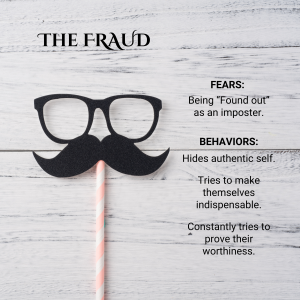
A black paper disguise with glasses and a mustache on a stick rests against a white wooden background next to text describing the Fraud Faulty Program’s fears and behaviors.

The Fears Driving the Fraud Program

At its core, the Fraud program is driven by a powerful fear of exposure and loss. Leaders believe that if their perceived inadequacies are revealed, they will lose respect, credibility, opportunity, or everything they’ve worked for.

Common Fraud Fears include:

  • Fear of being exposed as “not enough.”
  • Fear of losing a role, reputation, or livelihood
  • Fear that success was accidental or undeserved
  • Fear that authenticity will lead to rejection or judgment
  • Fear that others are more capable and will eventually outshine them

When the Dropout is talking, the internal head trash sounds like:

  • “I don’t deserve to be here.”
  • “They’re going to realize I’m not qualified.”
  • “I tricked them into thinking I’m better than I am.”
  • “If they really knew me, I’d lose this role.”

Over time, this fear keeps leaders locked in self-protection mode. Instead of expanding into their leadership, they shrink, hide, or exhaust themselves trying to prove worth that already exists.

The Costs of the Fraud Faulty Program

For Leaders

Leaders running the Fraud often experience:

  • Chronic self-doubt and anxiety
  • Burnout from constant over-performance
  • Avoidance of stretch opportunities or visibility
  • Disconnection from their authentic identity
  • A persistent feeling of never being “enough,” no matter how much they achieve

For Organizations

Organizations also pay a price when the Fraud hijacks leaders:

  • Underutilized talent and leadership potential
  • Hesitation around innovation or risk-taking
  • Lower psychological safety and authenticity
  • Reduced succession readiness
  • Lost opportunities when leaders self-sabotage advancement

When leaders are busy hiding or proving themselves, they are not fully available to lead boldly, creatively, or sustainably.

📊 Want to dig deeper? Download our free research paper, Future-Proofing Leadership: What It Takes to Thrive Amidst Change and Disruption, to explore the findings from our study of 250 leaders across industries.
Where Leaders Get Stuck (Our Data)

Our research suggests that leaders running the Fraud program are most challenged in adaptive change areas that require visibility, confidence, and self-trust.

  1. Speaking Up Courageously – 44%
    Our analysis found that 44 percent of leaders running the Fraud want to speak up with greater confidence, yet often stay quiet when their leadership voice is most needed. With a constant underlying fear of being “found out”, it feels safer not to take the risk of exposure. Instead, leaders second-guess themselves, often becoming invisible and reducing their ability to influence and contribute meaningfully.

  2. Setting Boundaries – 44%
    The same percentage of leaders (44 percent) in our analysis want to get better at setting and honoring healthy boundaries, yet the head trash of the Fraud gets in their way. When every place they turn, they fear the other shoe dropping and opportunities being taken away or being exposed, they will work overtime trying to prove themselves and somehow feel “enough” – making it extremely difficult to have a healthy relationship with boundaries.

  3. Fostering Accountability – 22%
    22 percent of leaders in our analysis who are running the Fraud program want to improve at setting and aligning with clear goals and expectations, and fostering greater accountability to meet those objectives. But their fear of not deserving their position or of being found out gets in the way of calling others to greatness. They can sometimes find themselves believing the head trash telling them, “Who am I to say anything?”

  4. Tending to the People Side of Leadership – 22%
    Although everyone in our data set has a formal people leadership role, it doesn’t mean they don’t want – and need – to improve their people leadership skills. In fact, 22 percent of leaders running the Fraud get stuck when it comes to being intentional to take time to connect with others and nurture relationships, foster collaboration, and recognize others in a meaningful way. Instead, their need to prove themselves keeps them more task-focused and missing out on nurturing the critical human-centric skills that are essential to being effective and future-ready.

  5. Intentional Time Management – 22%
    22 percent of leaders in our analysis who are running the Fraud program also struggle to be intentional about how they manage their time. These leaders want to be more effective at prioritizing and honoring scheduled time for key work (including prep and follow-up items), and at devoting time to work ON the business rather than just working IN the business. However, the Fraud’s head trash and fear of being “found out” keeps them stuck in a second-guessing cycle or in a constant effort to prove themselves.

When you reflect on the areas where leaders running the Fraud want to grow but find themselves stuck in adaptive change territory, it’s not surprising that two-thirds of Fraud leaders want to either get better at some aspect of communication or decision-making. It makes complete sense, as this program leads to constant second-guessing and self-protection. Adding more tips and tricks won’t get you very far when leaders believe they don’t belong and every moment of visibility feels risky. Without upgrading the Fraud, no amount of skills training can override the fear-based wiring underneath.

Why We Get in Our Own Way

Like other Faulty Programs, the Fraud is not a character flaw—it’s outdated wiring. Many leaders developed this program early in life through experiences where authenticity, vulnerability, or difference felt unsafe. Messages—explicit or implicit—taught them that who they truly were wasn’t acceptable, or that success had to be earned through perfection, performance, or self-denial.

As adults, their nervous systems still react as if exposure equals danger. Even when reality no longer supports that belief, the brain continues to protect against an old threat that no longer exists.

Breaking Free: The Upgrade Process

Upgrading the Fraud isn’t about convincing yourself you’re “good enough.” It’s about dismantling the belief that your worth is conditional.

1. Name It

Notice when the Fraud hijacks your thinking.

“There’s my Fraud—telling me I don’t belong and need to hide.”

Naming it interrupts the automatic spiral.

2. Own It

Map your personal expression and origin.

Expression:
Where do you fear being exposed? When do you over-prepare, hide, or avoid opportunity?

Origin:
Identify 3–5 early experiences that taught you that your authentic self wasn’t enough or wasn’t safe to reveal.

Acknowledging where this came from builds compassion and reduces shame.

“This program protected me once—but it’s no longer serving me.”

3. Challenge It (Upgrade)

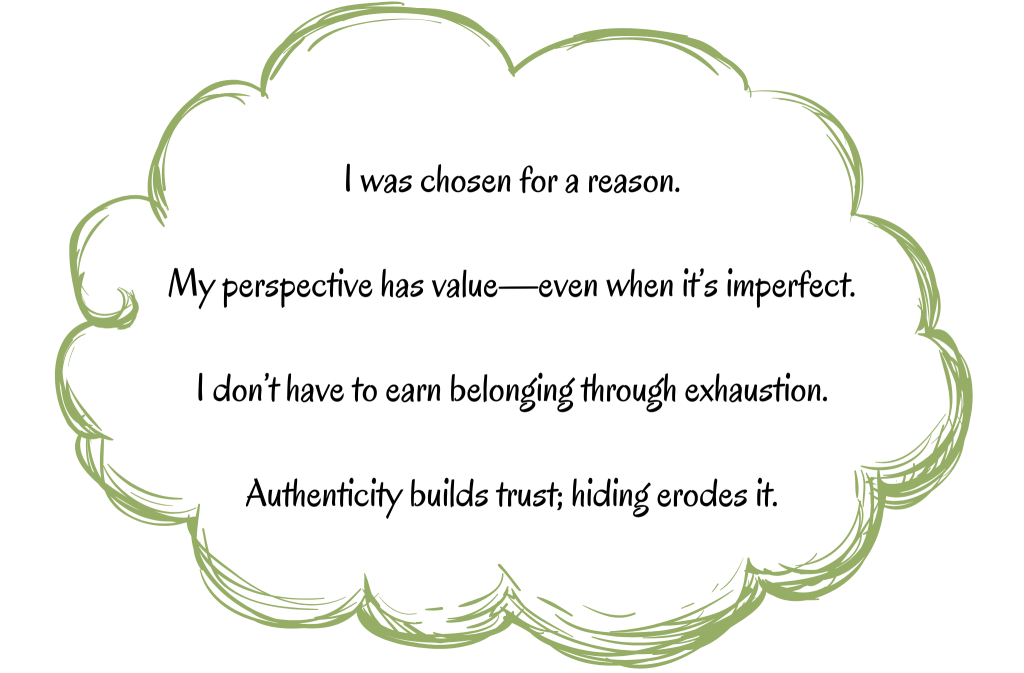
Replace the head trash with grounded truths:

A hand-drawn cloud outline contains affirming statements about worth, belonging, and authenticity related to overcoming imposter feelings.

Run micro-experiments to disprove the old wiring:

  • Share a perspective without over-preparing
  • Accept praise without deflecting
  • Apply for an opportunity before you feel “ready”
  • Let yourself be seen without over-explaining

Each rep weakens the Fraud’s grip and strengthens self-trust. As you increasingly start to embrace who you authentically are, the next step is to practice leaning into vulnerability more and bringing more of your authentic self forward. When your “I’m an imposter” or “they’ll find me out” head trash tries to take over, remind yourself that you are here for a reason.

And if you respect the person who hired you or gave you an opportunity, consider that you’re actually undermining and devaluing them by not absorbing the belief they have in you. Temporarily borrow their belief in you and see what starts to shift. Then start working to upgrade your Counterfeit and Overachiever program (if you have this double-whammy combination).

Steps You Can Take This Week

✅ Practice imperfect contribution in one meeting or conversation
✅ Name your Fraud when it appears
✅ Ask someone you trust why they believe in you
✅Stop one unnecessary over-preparation habit
✅ Practice receiving a compliment without minimizing it
✅ Take one small step toward visibility instead of hiding

Confidence grows through action—not isolation.

Moving Beyond the Fraud

Moving beyond the Fraud doesn’t mean the fear disappears overnight. It means the fear no longer runs the show. Leaders who upgrade this program stop living on borrowed confidence and start operating from grounded self-trust.

They show up more authentically, take healthier risks, and stop punishing themselves for being human. Their leadership presence expands, their energy returns, and their teams benefit from a leader who is no longer hiding behind competence or productivity.

At Salveo Partners, our Courageous Leadership Program helps leaders identify Faulty Programs like the Dropout, rewrite self-limiting stories, and build the habits required for sustainable, human-centered leadership.

What’s Next in This Series

This article is part of our ongoing series unpacking the Faulty Programs that keep leaders stuck in the Stuckness Zone™.

Next up: The Protector — When Taking On Too Much Keeps Leaders From Letting Others Rise.

Our aim is simple: normalize the messiness of being human, expose the invisible patterns holding leaders back, and provide actionable paths to help you—and your organization—thrive in a disruptive world.

Stay HUMAN. Stay connected. Stay safe. Show Up as a Leader.

Leave a Comment

Your email address will not be published. Required fields are marked *

#1 Individual Development:
The Foundation of Future-Ready Leadership

Leadership development is under greater pressure than ever, yet many organizations still invest in programs that don’t stick.

That’s why Salveo Partners is hosting a new 3-part webinar series for company leaders and HR teams to explore how strengthening leadership across three critical areas can create the conditions for sustainability and greater team and organizational success.

Everyone who registers will receive a link to the recording.

DIGITAL DOWNLOAD

Use this PDF as a visual guide to see how well you are supporting The Fusion of organizational and employee wellbeing and what it takes to have a thriving workplace culture.

This field is for validation purposes and should be left unchanged.
Name
Additional Options

Please fill-up the form to download your file.

We can help you!

Your Name