The Dropout: When Fear of “Sounding Stupid” Silences Your Leadership

For many leaders, the fear of being wrong, sounding stupid, or being perceived as incompetent quietly shapes their behavior more than they realize. The Dropout Faulty Program is one of our “cousin” programs—not as prevalent as the core seven, but incredibly powerful because it never travels alone. It appeared in 16% of leaders in our research and consistently pairs with the Mime, Control Freak, and Overachiever programs, creating unique patterns of self-sabotage.

Unlike the core programs, the Dropout rarely takes the wheel on its own. Instead, it fuels and intensifies other faulty patterns—convincing leaders to withhold their voice, hide their thinking, or overcompensate by proving how smart or capable they are.

This article is part of our Faulty Programs series. If you’re new here, start with our opener—“Why Leaders Get Stuck: The Stuckness Zone™ and Faulty Programs.” It lays the groundwork for what Faulty Programs are, how they form, and why upgrading them is essential for future-ready leadership.

How the Dropout Faulty Program Shows Up

The Dropout is rooted in the fear of being perceived as stupid or incompetent. Leaders running this program either shrink back to avoid exposure or surge forward, overcompensating for their intelligence or expertise.

It can sound or look like:

  • “I don’t want to say anything that makes me sound stupid.”
  • “People are counting on me to have the right answers.”
  • “I don’t want people to think I don’t know what I’m doing or that I am not competent.”
  • “If I don’t prove I know what I’m doing, I’ll lose credibility.”
  • “My value comes from being the smart one.”

Behaviorally, it often shows up as:

  • Avoiding speaking up—even when you have value to add
  • Hijacking conversations to demonstrate competence
  • Over-preparing or overworking to prevent being questioned
  • Taking over tasks or projects to avoid being exposed

When paired with the Mime, the Dropout amplifies silence—leaders hold back to avoid saying something inaccurate or risking loss of credibility or respect.

When paired with the Control Freak, it fuels overcompensation—leaders take control to avoid appearing uninformed.

When paired with the Overachiever, it drives relentless striving—leaders achieve more and more in hopes of finally feeling smart or capable.
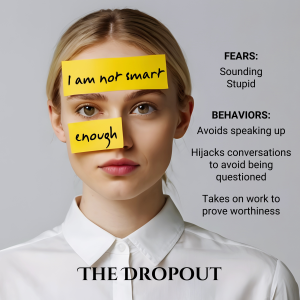
The Fears Driving the Dropout Program

The Dropout program is fueled by a deep fear of being exposed as unintelligent, unprepared, or inadequate. Leaders internalize the belief that competence is the primary measure of worth—and that any gap or uncertainty will be judged harshly. This fear can show up in subtle withdrawal or aggressive overperformance.

Common Dropout Fears include:

  • Fear of saying something incorrect and losing credibility
  • Fear of being asked a question they can’t answer
  • Fear of appearing unprepared, uninformed, or less capable
  • Fear that competence is their only value, so any mistake feels dangerous
  • Fear of judgment from peers, executives, or direct reports
    Fear of not being taken seriously or respected

When the Dropout is talking, the internal head trash sounds like:

  • “If I speak up and I’m wrong, everyone will realize I’m not as smart as they think.”
  • “I should already know this—asking for help will expose me.”
  • “If I admit uncertainty, they’ll question why I’m in this role.”
  • “Don’t say anything until you’re 100% sure.”
  • “If I don’t prove myself, I’ll lose credibility.”

These narratives create an internal climate where psychological safety collapses—not because the environment is unsafe, but because the leader’s inner critic is running the show. Over time, the Dropout convinces leaders that silence or overcompensation is the safest route, robbing them of authenticity, connection, and influence. Ironically, the protective strategies produce the very outcomes they fear: diminished credibility, strained relationships, and lost opportunities to lead boldly.

The Costs of the Dropout Faulty Program

For Leaders

Leaders running the Dropout often experience:

  • Chronic second-guessing and rumination
  • Avoidance of difficult or growth-oriented conversations
  • Reduced confidence and visibility
  • Burnout from overcompensating
  • Disconnection from their authentic leadership voice

For Organizations

Teams and cultures feel the impact when the Dropout hijacks a leader:

  • Slower decisions due to withheld insights
  • Reduced innovation and psychological safety
  • Increased frustration from micromanagement or conversation hijacking
  • Less open dialogue, collaboration, and healthy debate
  • Lost opportunities for growth and problem-solving

When leaders are either silent or overcompensating, organizations lose access to their clarity, creativity, and courage.

📊 Want to dig deeper? Download our free research paper, Future-Proofing Leadership: What It Takes to Thrive Amidst Change and Disruption, to explore the findings from our study of 250 leaders across industries.

Where Leaders Get Stuck (Our Data)

Our research identified several areas of adaptive change where the Dropout program is most pronounced. Each reflects a moment where leaders must navigate visibility, imperfection, and intellectual vulnerability.

  1. Growth Feedback – 32%
    Delivering feedback requires presence, clarity, and the willingness to navigate uncertainty. Our analysis found that 32 percent of Dropout-driven leaders want to improve their growth feedback conversations but avoid them because they fear being caught off guard or challenged. They also fear appearing unqualified to coach others. As a result, performance issues persist, frustration mounts, and employees miss growth opportunities. Leaders carry the emotional toll of avoidance, and the organization bears the cost of stalled development.

  2. Speaking Up Courageously – 26%
    Our analysis found that 26 percent of leaders running the Dropout want to speak up with greater confidence, yet often stay quiet when their leadership voice is most needed. They wait to speak until their ideas feel “perfect,” and by then the conversation has moved on. This self-silencing diminishes confidence and reduces influence. Over time, teams may interpret silence as disengagement or a lack of insight, even when the leader is internally overprocessing. This ultimately erodes trust and limits contribution.

  3. Emotional Regulation – 26%
    Another area where Dropout leaders find themselves challenged is their mindsets that allow them to pause, be curious, practice patience and understanding, and respond in a more neutral manner—especially when things don’t go as planned. Our analysis showed that 26 percent of leaders running this faulty program want to improve regulating their emotions, but frequently get sucked into the reactionary trap.

  4. Fostering Accountability – 23%
    Nearly one quarter (23 percent) of leaders in our analysis who are running the Dropout program want to improve at setting and aligning with clear goals and expectations, and fostering greater accountability to meet those objectives. But fear of saying something incorrect or fumbling during accountability-related conversations gets in their way.

  5. Intentional Time Management – 23%
    Nearly one quarter (23 percent) of leaders running the Dropout program also struggle to be intentional about how they manage their time. These leaders want to be more effective at prioritizing and honoring scheduled time for key work (including prep and follow-up items), and at devoting time to work ON the business rather than just working IN the business. However, the Dropout’s head trash keeps them stuck in a second-guessing cycle or in a constant effort to prove themselves.

When you reflect on the areas where leaders running the Dropout want to grow but find themselves stuck in adaptive change territory, it’s not surprising that an overwhelming 81 percent of Dropout leaders want to get better at some aspect of communication. It makes complete sense since this program leads to either holding back or taking over in unhelpful ways. Adding more tips and tricks won’t get you very far until this program is upgraded and no longer feels too cringy.

Why We Get in Our Own Way

Most leaders don’t realize that their Dropout program is rooted in early experiences—moments when a childhood teacher, coach, or parent equated intelligence with worthiness or harshly punished mistakes. These early moments of wiring form internal narratives about competence and safety that persist into adulthood.

When leaders operate from these outdated codes, they show up as their 10-year-old selves rather than their present-day, highly capable selves. Their brains respond to the threat of appearing foolish rather than to the reality of the situation.

Breaking Free: The Upgrade Process

Upgrading the Dropout is not about pretending to know more or pushing yourself to perform magically better. It’s about letting go of the belief that your worth hinges solely on competence and reclaiming your authentic leadership voice.

1. Name It

Recognize when the Dropout hijacks your thinking:

“There’s my Dropout—trying to keep me safe by staying quiet.”
“There’s my Dropout—pushing me to dominate the conversation to prove myself.”

2. Own It

Map your personal expression and origin.

Expression:
When do you hold back? When do you over-talk? When does the fear of incompetence shrink or inflate your behavior?

Origin:
Identify 3–5 early experiences that may have led you to conclude that either you’re not smart or competent enough or that being smart is your primary value, so you need to protect it or assert it wherever you can.

Owning the origin softens shame and builds compassion.

“This program helped me survive old circumstances—but it’s not serving who I am today.”

3. Challenge It (Upgrade)

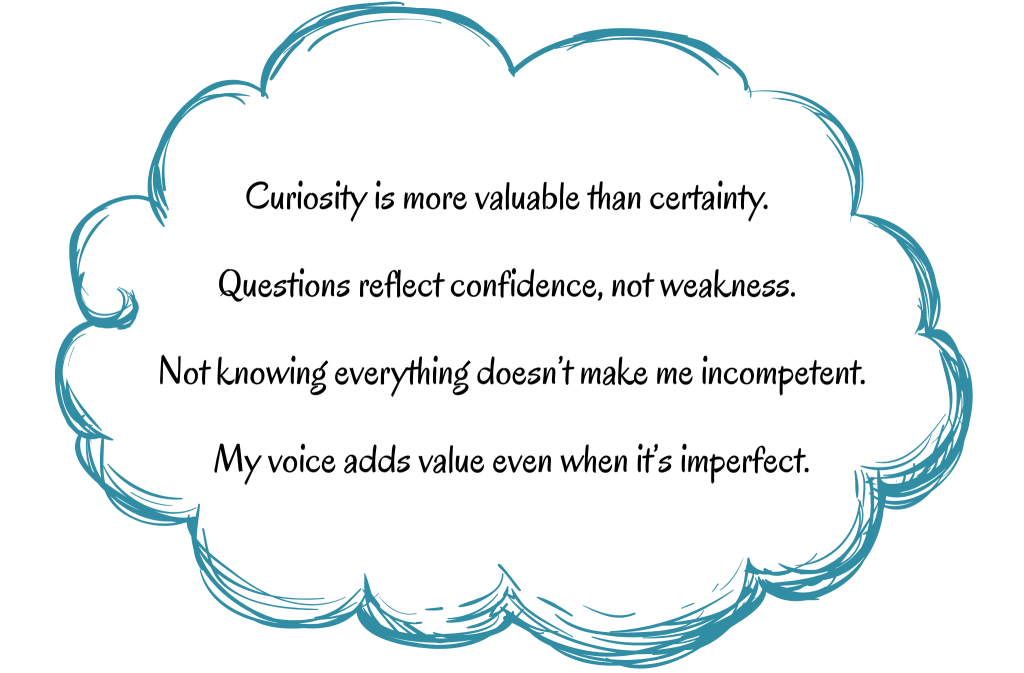
Replace the head trash with grounded, sticky truths:

Run micro-experiments to disprove the old wiring:

  • Speak 10% sooner in meetings before your thoughts feel finished
  • Ask one clarifying question instead of pretending to know
  • Delegate a task and resist the urge to redo it
  • Share an early draft and request input
  • Tell your team openly: “Here’s what I’m thinking—I’d love your perspectives.”

Each experiment rewires the internal belief system. Then you can follow the steps in a previous blog to upgrade the core program, while riding shotgun with the Dropout (Mime, Control Freak, or Overachiever), as they go hand in hand.

Steps You Can Take This Week

✅ Practice imperfect contribution in one meeting or conversation

✅Name your Dropout aloud when it appears

✅Ask a trusted colleague: “What strengths do you see in how I think or contribute?”

✅Replace one self-doubt thought with a new truth (i.e., “I can add greater value by asking thoughtful questions or elevating others than proving how much I know.”)

Building confidence through action—not rumination—is the key.

Moving Beyond the Dropout

Moving beyond the Dropout isn’t about pretending you have all the answers—it’s about letting go of the belief that you’re only valuable when you do. Leaders who upgrade this pattern rediscover their authentic voice, operate from curiosity rather than self-protection, and experience deeper trust with their teams. They learn to share ideas before they’re polished, ask questions without shame, and delegate without fear of exposure.

As the Dropout loosens its grip, leaders stop managing perceptions and start leading with grounded confidence. They become more approachable, collaborative, and innovative. Their teams feel more empowered, and their organizations benefit from faster learning, stronger relationships, and bolder decision-making. Ultimately, moving beyond the Dropout frees leaders to operate from who they truly are—capable, evolving, and human—rather than who their fears insist they must be.

At Salveo Partners, our Courageous Leadership Program helps leaders identify Faulty Programs like the Dropout, rewrite self-limiting stories, and build the habits required for sustainable, human-centered leadership.

What’s Next in This Series

This article is part of our ongoing series unpacking the Faulty Programs that keep leaders stuck in the Stuckness Zone™.

Up next: The Fraud and why feeling like an imposter keeps leaders playing small (and how to stop).

Our aim is simple: normalize the messiness of being human, expose the invisible patterns holding leaders back, and provide actionable paths to help you—and your organization—thrive in a disruptive world.

Stay HUMAN. Stay connected. Stay safe. Show Up as a Leader.

Leave a Comment

Your email address will not be published. Required fields are marked *

#1 Individual Development:
The Foundation of Future-Ready Leadership

Leadership development is under greater pressure than ever, yet many organizations still invest in programs that don’t stick.

That’s why Salveo Partners is hosting a new 3-part webinar series for company leaders and HR teams to explore how strengthening leadership across three critical areas can create the conditions for sustainability and greater team and organizational success.

Everyone who registers will receive a link to the recording.

DIGITAL DOWNLOAD

Use this PDF as a visual guide to see how well you are supporting The Fusion of organizational and employee wellbeing and what it takes to have a thriving workplace culture.

This field is for validation purposes and should be left unchanged.
Name
Additional Options

Please fill-up the form to download your file.

We can help you!

Your Name