The Martyr: Why Going It Alone Keeps Leaders Stuck

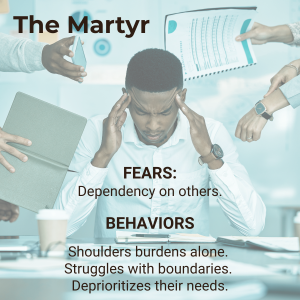
The Martyr Faulty Program is one of the most quietly draining patterns we see in leadership. In our analysis, 19 percent of leaders run this program, which drives a deep belief that “I have to do it myself” or “my needs don’t matter.” Leaders operating from this faulty wiring tend to shoulder burdens alone, deprioritize their own needs, and struggle to rely on others—often believing it’s selfish, weak, or risky to ask for help.

This article is part of our Faulty Programs series. If you’re new here, start with our opener—“Why Leaders Get Stuck: The Stuckness Zone™ and Faulty Programs.” It lays the groundwork for what Faulty Programs are, how they form, and why upgrading them is essential for future-ready leadership.

How the Martyr Faulty Program Shows Up

Leaders running the Martyr often assume they must be hyper-independent and constantly available. They value being seen as responsible and helpful, but this comes at the cost of their well-being.

It can sound or look like:

  • “I can’t rely on others.”
  • “I don’t want to be a burden.”
  • “My needs don’t matter.”
  • “I have to handle everything myself.”

Behaviorally, Martyr tendencies often show up through:

  • Taking on more than is reasonable or sustainable.
  • Avoiding advocating for needs or boundaries.
  • Feeling compelled to be always available or responsive.
  • Experiencing quiet resentment, exhaustion, or overload.

The Martyr becomes a self-reinforcing loop: the more leaders take on, the more others expect them to handle. And the more they deprioritize themselves, the harder it becomes to break free.

The Fears Driving the Martyr Program

At its core, the Martyr is fueled by dependency fears—fear of being a burden, fear of appearing selfish, or fear that others can’t be counted on and won’t follow through. Many leaders learned early in life that they had to be self-sufficient or that advocating for their needs wasn’t safe or acceptable.

Common Martyr fears include:

  • Fear of appearing selfish.
  • Fear of relying on others.
  • Fear of letting people down.
  • Fear of not being needed or valued.

When the Martyr is talking, the internal head trash sounds like:

  • “I have to be self-reliant; I can’t count on others.”
  • “I need to take care of things myself.”
  • “I don’t want to be a burden / appear selfish to others.”
  • “My needs don’t matter/don’t count.”

Underneath these fears is a painful assumption: “My needs don’t matter to others, and I’m on my own.” And that belief quietly shapes behavior until leaders examine and upgrade it.

The Costs of the Martyr Faulty Program

For Leaders
Running the Martyr comes with high emotional and physical costs, including:

  • Chronic overwhelm and burnout
  • Difficulty setting or honoring boundaries
  • Resentment from constantly overextending
  • Limited capacity for strategic, high-value work
  • Emotional reactivity from overload

For Organizations
When leaders consistently take on too much, the entire system pays a price:

  • Team underdevelopment (because the leader “just does it”)
  • Bottlenecks in decision-making
  • Erosion of psychological safety
  • Decreased innovation due to over-functioning leaders
  • Cultural norms of overwork and constant responsiveness

The Martyr may seem dedicated, but they ultimately create fragility—both for the leader and the organization.

📊 Want to dig deeper? Download our free research paper, Future-Proofing Leadership: What It Takes to Thrive Amidst Change and Disruption, to explore the findings from our study of 250 leaders across industries.

Where Leaders Get Stuck (Our Data)

Our analysis revealed that the Martyr program most commonly sabotages leaders in four adaptive change areas:

  1. Setting Healthy Boundaries (35%)
    The biggest area in which Martyr leaders feel challenged is with setting and honoring healthy boundaries. Specifically, our analysis showed that 35 percent of the leaders running the Martyr program want to get better but find difficulties in constructing healthier boundaries between work and home, having more downtime, being present with their families when at home, and being more diligent in tending to their own well-being and self-care. It makes complete sense because the head trash of this faulty program tells us that our needs ultimately don’t matter. Trying to advocate for ourselves by having boundaries and tending to our own well-being directly contradicts the messages entrenched in the Martyr program.

  2. Speaking Up with Confidence (28%)
    Given that the Martyr leads us to believe that our needs don’t matter or that advocating for ourselves could be perceived as selfish, it’s not surprising that our research found that 28 percent of leaders running this faulty program struggle to speak up with confidence. Even though leaders may want to have their voices heard and to advocate for their thoughts and ideas, this program’s head trash tells them that no one will listen or that they’ll be seen as selfish or ego-driven. So they keep our thoughts to themselves while a deep longing or resentment brews inside.

  3. Growth Feedback Conversations (24%)
    According to our analysis, nearly one quarter of leaders (24 percent) struggle to have growth feedback conversations when they’re running the Martyr. It makes sense because the head trash of this faulty program has us believe that our needs don’t matter. If we’re trying to elevate someone else and give feedback based on our experiences or perceptions, this faulty program can easily trigger thoughts that we’re coming across as selfish or that people won’t respect or listen to us. Consequently, similarly to leaders who struggle to speak up with confidence and clarity, we tend to avoid or fumble through those conversations because it likely feels easier to do things ourselves than to go through the discomfort of trying to grow and elevate others.

  4. Emotional Regulation (24%)
    The exact number of leaders who struggle but want to get better at growth-feedback conversations also want to improve their ability to regulate their emotions. But instead, they end up hijacked by reactivity. Think about it. If we’re constantly doing things ourselves because we think others won’t help us or do it as well as we will, we can’t rely on others, or our needs don’t matter, we will constantly suppress frustration, resentment, and feelings that come when we’re overloaded. In that state, it is difficult to regulate our emotions so that we can stay calm and curious, be patient and understanding, and respond to others more neutrally. It’s like the lid on a pot of boiling water just waiting to pop off at any moment. We can only ignore our own needs for so long before something must give.

These aren’t skills issues. They’re fear-based patterns rooted in outdated beliefs about worth, responsibility, and self-reliance.

Why We Get in Our Own Way

The Martyr often originates in childhood experiences in which leaders learned they had to be self-sufficient, helpful, or accommodating to maintain stability or connection. Many watched important people around them deprioritize their own needs or dismiss boundaries, unintentionally teaching them to do the same.

As adults, leaders replicate those survival strategies—overextending, self-silencing, and trying to hold everything together—long after the original context has passed.

Breaking Free: The Upgrade Process

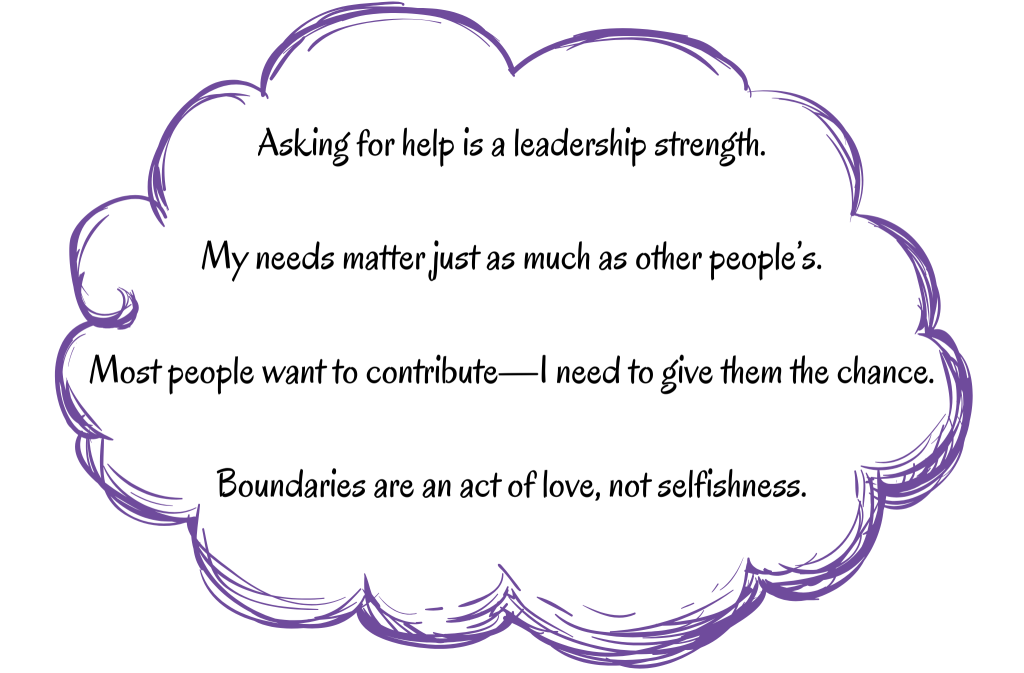
Upgrading the Martyr isn’t about becoming selfish or detached—it’s about learning that your needs matter just as much as anyone else’s and that letting others contribute is an act of trust, not weakness.

1. Name It
Noticing when the Martyr is driving your thoughts or behaviors interrupts the autopilot.

“There’s my Martyr again—telling me I have to do everything myself.”
“I’m not ten years old anymore. My needs matter too.”

2. Own It
Map your personal expression and origin.

Expression:
Identify how the Martyr shows up for you:

  • Where do you overextend?
  • When do you stay silent instead of advocating for yourself?
  • Where do you take on more than is yours to carry?

Origin:
Identify 3–5 early experiences that led you to be self-reliant, not to burden others, or to deprioritize yourself. Naming the origin softens shame and normalizes the pattern.

Acknowledge what the Martyr once protected you from—and how it limits you now.

“This program helped me feel safe when I was young. But today, it keeps me small.”

3. Challenge It (Upgrade)
Replace the head trash with grounded, empowering statements:

Run micro-experiments.

Collect data that slowly disproves the lies the Martyr has sold you. 

  • Gather feedback: Ask people who know you well the following question: “What is it like for you to be around me when I’m in a mode of doing everything myself or deprioritizing my needs?” It will likely sting – and that’s a good thing. When you hear things ranging from people feeling like you don’t trust them to being worried about you. The point is to create a moment of pause the next time you’re over-focused on doing everything yourself or on ignoring your needs.

  • Practice micro-bravery: Find small moments where you can either advocate for yourself or call others to greatness. For example, ask for or accept help from others; delegate one task intentionally without jumping in; or say “no” kindly when you don’t have the interest or capacity.

  • Embrace the power of the pause: Be intentional about pausing before responding (to quiet the reactivity that needs to jump in and take care of things); give others a chance to step in and notice what happens. Also, practice boundaries by unplugging for an evening or honoring blocked focus time; creating pauses in your day can be powerful for your well-being and effectiveness.

These experiments help your brain see that relying on others is safe—and often better – than trying to do everything yourself.

Steps You Can Take 

Set one small boundary.
Protecting your energy builds confidence and reduces resentment.

Let someone help you.
Practice receiving without over-explaining or apologizing.

Say “I need…” once.
Advocate for a need, however small, to disrupt the old pattern.

Delegate one task fully.
Let others contribute—it strengthens teams and builds trust.

Notice resentment.
It’s a signal that a boundary is needed.

These small steps create momentum toward authentic, courageous communication.

Moving Beyond the Martyr

When leaders upgrade the Martyr program, they shift from hyper-independence to healthy interdependence. They stop carrying everything alone and begin distributing ownership, strengthening collaboration, and creating more sustainable leadership rhythms. They move from:

  • “I have to do it all.” → “We rise together.”
  • “My needs don’t matter.” → “My well-being fuels my leadership.”
  • “I can’t rely on others.” → “People want to help when I let them.”

At Salveo Partners, our Courageous Leadership Program helps leaders identify Faulty Programs like the Martyr, rewrite self-limiting stories, and build the habits required for sustainable, human-centered leadership.

What’s Next in This Series

This article is part of our ongoing series unpacking the Faulty Programs that keep leaders stuck in the Stuckness Zone™.

Up next: The Dropout and why the fear of sounding incompetent silences even the smartest leaders.

Our aim is simple: normalize the messiness of being human, expose the invisible patterns holding leaders back, and provide actionable paths to help you—and your organization—thrive in a disruptive world.

Stay HUMAN. Stay connected. Stay safe. Show Up as a Leader.

Leave a Comment

Your email address will not be published. Required fields are marked *

#1 Individual Development:
The Foundation of Future-Ready Leadership

Leadership development is under greater pressure than ever, yet many organizations still invest in programs that don’t stick.

That’s why Salveo Partners is hosting a new 3-part webinar series for company leaders and HR teams to explore how strengthening leadership across three critical areas can create the conditions for sustainability and greater team and organizational success.

Everyone who registers will receive a link to the recording.

DIGITAL DOWNLOAD

Use this PDF as a visual guide to see how well you are supporting The Fusion of organizational and employee wellbeing and what it takes to have a thriving workplace culture.

This field is for validation purposes and should be left unchanged.
Name
Additional Options

Please fill-up the form to download your file.

We can help you!

Your Name