The People-Pleaser: When Approval Becomes the Enemy of Authenticity

It’s human nature to seek belonging, connection, and acceptance. But when the need to please overshadows authenticity, leaders find themselves running one of the most common—and costly—Faulty Programs: The People-Pleaser.

In our research with 250 leaders across industries, nearly one in four exhibited strong People-Pleaser tendencies. While these leaders are often well-liked, empathetic, and collaborative, their deeper motivation isn’t always generosity—it’s fear. Fear of rejection. Fear of disappointing others. Fear of not being liked or loved.

On the surface, the People-Pleaser appears to be a relational strength. But over time, it drains confidence, clouds decision-making, and creates frustration for everyone involved. When approval becomes the metric for safety, authenticity becomes the casualty.

This article is part of our Faulty Programs series. If you’re new here, start with our opener—“Why Leaders Get Stuck: The Stuckness Zone™ and Faulty Programs.” It lays the groundwork for what Faulty Programs are, how they form, and why upgrading them is essential for future-ready leadership.

How the People-Pleaser Faulty Program Shows Up

The People-Pleaser program is rooted in a deep need for belonging that feels conditional, where rejection is a constant threat. Leaders who run this pattern prioritize being liked over honesty, often sacrificing their own needs, opinions, or boundaries to be accepted by others.

Behaviorally, it often shows up as:

  • Saying yes when you mean no.
  • Avoiding difficult conversations or sugarcoating feedback.
  • Withholding our needs or opinions so as not to go against a person or group inadvertently.
  • Over-apologizing or taking responsibility when others are upset.
  • Adapting your personality to meet the expectations of whoever is in the room.

While the intention is to create connection, the impact is often the opposite: others sense inauthenticity, trust weakens, and resentment builds—both internally and within teams. Because, although it is human nature to care what other people think, when we are defined by it, we lose our capacity to lead.
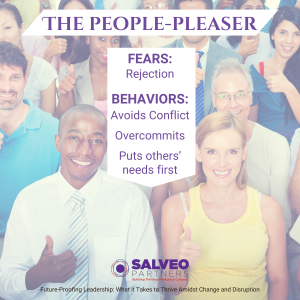


The Fears Driving the People-Pleaser

Many lightheartedly joke about having people-pleasing tendencies, but that masks often early-formed fears. At the core is a deep fear of rejection that also shows up as:

  • Fear of letting people down.
  • Fear of not being liked
  • Fear of not being loved.

When the People-Pleaser is in the driver’s seat, the head trash sounds like:

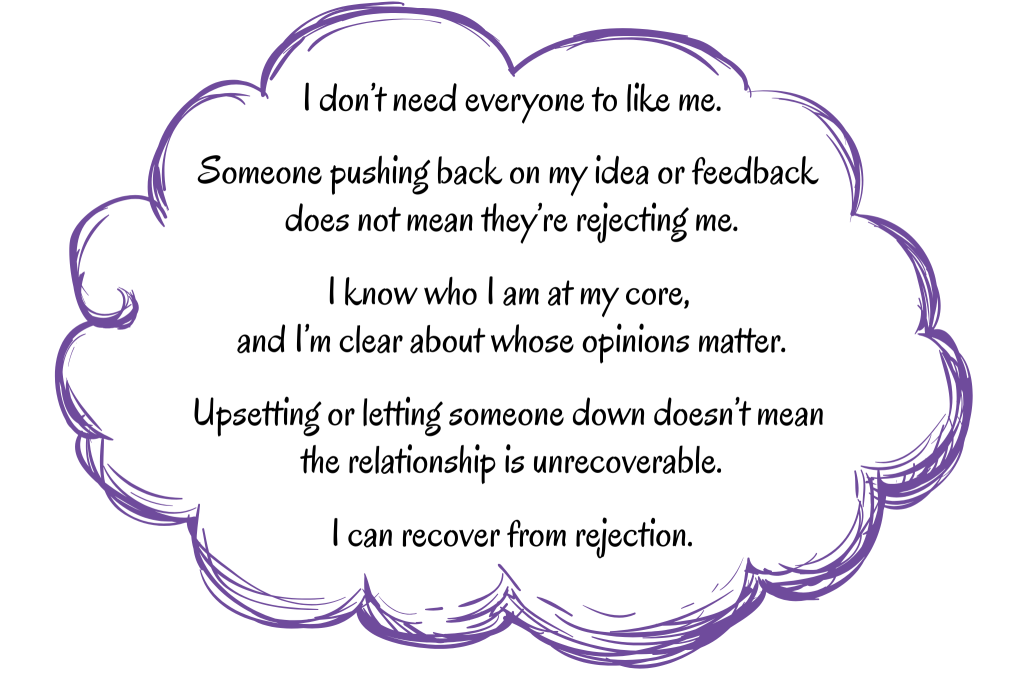
  • I can’t let people down and still be liked, respected, or loved.
  • I can’t upset people and have the relationship be recoverable.
  • I’m an outsider on this team or in this group, and I don’t belong.
  • My value comes from keeping other people happy.

Underneath that belief sits a powerful assumption: Belonging and acceptance are fragile and conditional.

That fear keeps leaders focused on harmony at all costs—even when it means silencing their own truth. The People-Pleaser’s unspoken mantra becomes: “It’s better to abandon myself than risk disappointing you.” When the People-Pleaser is in the driver’s seat, we twist ourselves into pretzels trying to appease everyone else’s needs before our own at the cost of our well-being, effectiveness, and confidence.

The Costs of the People-Pleaser Program

For Leaders

When leaders run the People-Pleaser program, the short-term payoff of fitting in often comes at a long-term cost. Over time, they:

  • Lose touch with their own values, opinions, and preferences.
  • Feel drained from constantly trying to meet others’ expectations.
  • Struggle to make decisions confidently or say no without guilt.
  • Harbor quiet resentment when overextending themselves.
  • Experience burnout from trying to keep everyone happy.
  • Erode self-trust by consistently prioritizing others’ approval over their own integrity.

For Organizations

While People-Pleasers may create a “nice” culture on the surface, the underlying dynamics can quietly undermine performance and trust. Organizations often experience:

  • Lack of clarity and direction due to leaders avoiding difficult conversations.
  • Reduced accountability when underperformance goes unaddressed.
  • Hidden conflict and tension that never gets resolved.
  • Slower decision-making because leaders seek consensus or avoid pushback.
  • Erosion of psychological safety—team members sense inauthenticity and hold back their own voices.
  • A culture of compliance rather than courageous contribution.

When the People-Pleaser is in the driver’s seat, resentment and frustration quietly brew and build, and a lack of clarity grows. “Nice” is not the same as kind. Being clear is kind, but we can’t see that when this program takes over.

📊 Want to dig deeper? Download our free research paper, Future-Proofing Leadership: What It Takes to Thrive Amidst Change and Disruption, to explore the findings from our study of 250 leaders across industries.
Where Leaders Get Stuck (Our Data)

Our analysis revealed that the People-Pleaser program often sabotages leaders in four key adaptive change areas:

  • Growth Feedback (38%) – The area where the most People-Pleaser leaders find themselves challenged is having growth feedback conversations rather than protecting relationships. Specifically, our analysis found that 38 percent of the leaders running this Faulty Program would probably rather have a root canal than risk a conversation where they might upset someone. Yet they know it’s important and want to get better at it. Think about it. If we’re running a program that tells us anyone being upset with us automatically means that they don’t like us or that the relationship won’t be recoverable, of course, we’re going to avoid the potential discomfort that inherently accompanies those conversations.

  • Fostering Accountability (35%) – Because setting clear expectations and fostering accountability to those expectations inherently risks upsetting someone, it’s easy to see why our analysis found that 35 percent of leaders running the People-Pleaser program want to improve in this area but struggle to do so. Leaders tend to either jump in and take care of things themselves rather than elevating others, or fall into passive, avoidant behaviors, saying things like, “I trust and empower my team.” They will assume that checking in on progress and firm goals will be insulting to team members, or that the team will perceive them as micromanagers.

  • Emotional Regulation (22%) – Our data found that 22 percent of leaders with the People-Pleaser program want to get better at pausing, being curious, responding in a more neutral manner, and being more patient and understanding. When they’re deeply concerned about being accepted, they’re likely on high alert for signs that they don’t belong. That state makes it harder to regulate emotions.

  • Speaking up (22%) – For leaders who are afraid to upset the apple cart, so to speak, it’s not surprising that our analysis found that 20 percent of leaders running the People-Pleaser program struggle with speaking up with confidence and conviction. After all, it’s hard to simply will yourself to speak more in meetings or let yourself be seen and heard when you’re afraid that putting yourself out there will automatically mean rejection.

These leaders aren’t lacking skill—they’re stuck in a subconscious loop that equates these behaviors with danger because of the risk of rejection.

Why We Get in Our Own Way

The People-Pleaser program usually originates in early experiences where belonging felt conditional. Perhaps love was earned by being agreeable, helpful, or easy to get along with. Maybe there was a time when you didn’t make the team, or when you were teased or rejected by a friend group. Over time, this teaches the brain that approval equals acceptance and rejection equals threat.

As adults, that wiring persists. The drive to be “the likable one” can lead leaders to abandon authenticity in favor of acceptance. The result? A leader who perhaps is well-liked—but quietly resentful and perpetually overextended.

Breaking Free: The Upgrade Process

Upgrading this program isn’t about becoming harsh or indifferent—it’s about learning to value truth over tension and authenticity over approval.

1. Name It
Start by catching it in real time. Notice when you soften your truth, avoid discomfort, or take on something that isn’t yours to own.

“There’s my People-Pleaser—trying to keep everyone happy so I can feel safe.”

2. Own It
Map your personal expression and origin.

  • Expression: When do you find yourself abandoning your authenticity to try to fit in? Where do you avoid speaking up? How does trying to have everyone like you hinder your relationships and effectiveness?
  • Origin: Identify 3–5 early experiences that led you to conclude that you don’t belong, can’t let people down, or need to avoid any possible rejection.

Acknowledge where it came from. This pattern was once a brilliant survival strategy—it helped you maintain connection in environments where potential rejection felt dangerous. Gratitude disarms shame.

“Thank you for helping me survive. But I don’t need you to run the show anymore.”

3. Challenge It (Upgrade)
Rewrite the script with targeted experiments.

Replace the head trash. Swap it with new short, sticky truths (belief will eventually set in with practice):

Run micro-experiments.

Collect data that slowly disproves the lies the People-Pleaser has sold you. Start small and test the belief that honesty or authenticity will lead to rejection:

  • Gather feedback: Ask people who know you well the following question: “What is it like for you to be around me when I’m in People-Pleasing mode and avoiding speaking up, overcommitting, and so on?” It will likely sting – and that’s a good thing. When you hear that people likely want you to speak up, set boundaries, or be more of your authentic self, it will likely cause a moment of pause the next time you’re over-focused on trying to be liked.

  • Practice micro-bravery: Find small moments where you can choose authenticity over fitting in. For example, say “no” kindly when you don’t have the interest or capacity; practice giving clear, direct feedback; or share a differing opinion in one meeting.

  • Model authenticity: Share your own missteps or needs to show that acting from your core values and authentic self doesn’t break the connection—it deepens it.

Remember that we’re not for everyone—and that’s okay. Countless people are judging, trolling, and waiting to take people down whom they don’t even know; so be clear about whose opinions actually matter. As you slowly become reacquainted with your authentic self, you’ll likely experience even greater connection and confidence.

Steps You Can Take 

Say “no” once a week—without apology or justification. Remember that “no” is a complete sentence.

Have one honest conversation you’ve been avoiding.

Ask yourself before saying yes: “Am I doing this from genuine care or from fear of disappointing?”

Journal or reflect: When have I chosen fitting in over truth or authenticity, and what was the cost?

Moving Beyond the People-Pleaser

When you upgrade the People-Pleaser program, something powerful happens—you rediscover your voice. You stop contorting yourself for connection and start building it through authenticity.

You become the kind of leader who can hold both compassion and candor, who can care deeply and still tell the truth.

Real connection requires realness. And the moment you stop needing everyone’s approval, you create the psychological safety for others to show up real, too.

So, the next time your inner People-Pleaser whispers, “Keep people happy,” try replying:

“Fitting in is not true belonging. I’m not for everyone, so I might as well be true to myself; after all, everyone else is taken.”

What’s Next in This Series

This article is part of our ongoing series that unpacks the Faulty Programs that keep leaders stuck in the Stuckness Zone. In the next installment, we’ll explore the Control Freak and how this program keeps leaders gripping the reins too tightly, and what it takes to lead with trust in an uncertain world.

Our aim is simple: normalize the messiness of being human, expose the invisible patterns holding leaders back, and provide actionable paths to help you—and your organization—thrive in a disruptive world.

Stay HUMAN. Stay connected. Stay safe. Show Up as a Leader.

Leave a Comment

Your email address will not be published. Required fields are marked *

#1 Individual Development:
The Foundation of Future-Ready Leadership

Leadership development is under greater pressure than ever, yet many organizations still invest in programs that don’t stick.

That’s why Salveo Partners is hosting a new 3-part webinar series for company leaders and HR teams to explore how strengthening leadership across three critical areas can create the conditions for sustainability and greater team and organizational success.

Everyone who registers will receive a link to the recording.

DIGITAL DOWNLOAD

Use this PDF as a visual guide to see how well you are supporting The Fusion of organizational and employee wellbeing and what it takes to have a thriving workplace culture.

This field is for validation purposes and should be left unchanged.
Name
Additional Options

Please fill-up the form to download your file.

We can help you!

Your Name