The Protector: When Carrying Too Much Keeps Leaders From Letting Others Rise

For some leaders, caring deeply turns into carrying everything. They feel responsible—not just for outcomes, but for how others feel, cope, and succeed. When things get hard, they step in. When someone struggles, they absorb it. When tension arises, they shield others from discomfort, stress, or consequences.

The Protector Faulty Program is rooted in a well-intentioned instinct: keep people safe. But when this program runs unchecked, it quietly limits leadership impact, erodes resilience, and prevents others from reaching their full potential.

In our research, the Protector emerged as a cousin program—less common than the core seven but powerful in how it amplifies and reinforces other faulty patterns. Leaders running the Protector often also exhibit Martyr, Mime, Overachiever, or Control Freak tendencies, creating a dynamic in which responsibility becomes over-ownership.

This article is part of our Faulty Programs series. If you’re new here, start with our opener—“Why Leaders Get Stuck: The Stuckness Zone™ and Faulty Programs.” It lays the groundwork for what Faulty Programs are, how they form, and why upgrading them is essential for future-ready leadership.

How the Protector Faulty Program Shows Up

At its core, the Protector is driven by the belief that “If I don’t step in, things will fall apart, or people will suffer.” Leaders running this program often see themselves as the emotional shock absorbers for their teams and organizations.

It can sound or look like:

  • “It’s my job to make this easier for them.”
  • “I hate seeing people struggle.”
  • “They can’t handle this_____ [feedback, news, workload].”
  • “If I don’t protect them, they’ll fail or burn out.”
  • “I can handle more than most people.”
  • “I don’t want to put this stress on anyone else or add any more to their plate.”

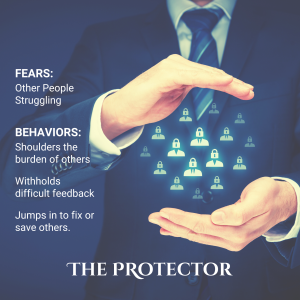
Behaviorally, it often shows up as:

  • Taking on emotional labor that isn’t yours to carry
  • Shielding others from feedback, consequences, or stretch
  • Over-functioning during stress or change
  • Jumping in to rescue rather than letting people struggle productively
  • Absorbing tension to keep things “stable.”

While the Protector often appears as generosity or strength, it quietly reinforces a dangerous dynamic: others don’t get to build capacity if leaders keep removing challenges.
The Fears Driving the Protector Program

The Protector is fueled by a deep fear of harm—emotional, relational, or professional. Leaders believe that if others experience discomfort, failure, or stress, something bad will happen that they’ll be responsible for.

Common Protector Fears include:

  • Fear of letting people down
  • Fear of overwhelming or hurting others
  • Fear of being the cause of someone else’s struggle
  • Fear of conflict or emotional fallout
  • Fear of being seen as uncaring or harsh
  • Fear that others won’t cope without intervention

When the Protector is talking, the internal head trash sounds like:

  • “They can’t handle this.”
  • “I should take this on so they don’t have to.”
  • “It’s safer if I manage this myself.”
  • “I don’t want to put them in a tough spot.”
  • “I don’t want to be the cause of their [negative emotions, bad experience, struggle].”

Over time, this fear keeps leaders locked in over-responsibility. Instead of empowering others, they unintentionally communicate: “I don’t trust you to carry this.

The Costs of the Protector Faulty Program

For Leaders

Leaders running the Protector often experience:

  • Chronic emotional fatigue
  • Blurred boundaries and overload
  • Resentment that feels confusing or unjustified
  • Limited strategic capacity
  • A sense of being indispensable—but exhausted

They may feel needed, but rarely supported.

For Organizations

When the Protector runs the system, organizations pay a price:

  • Underdeveloped talent and learned dependence
  • Bottlenecks around decision-making and ownership
  • Reduced accountability
  • Lower resilience during disruption
  • Leaders who burn out while teams stall

When leaders protect people from challenges, they also protect them from growth.

📊 Want to dig deeper? Download our free research paper, Future-Proofing Leadership: What It Takes to Thrive Amidst Change and Disruption, to explore the findings from our study of 250 leaders across industries.
Where Leaders Get Stuck (Our Data)

Our analysis suggests that leaders running the Protector program most often struggle with adaptive change that requires letting go, trusting others, and tolerating discomfort.

  1. Setting Boundaries – 30%
    Nearly one-third (30 percent) of leaders in our analysis want to improve at setting and honoring healthy boundaries, yet the head trash of the Protector gets in the way. When they keep shouldering other people’s burdens, of course, their plate is going to be constantly overloaded – making it extremely difficult to have a healthy relationship with boundaries.

  2. Growth Feedback – 26%
    Delivering feedback can be uncomfortable, especially when you don’t know how the other person will respond. And by definition, growth feedback means stretching someone beyond their comfort zone. So it’s not surprising that our analysis found that 26 percent of Protector-driven leaders want to improve their growth feedback conversations but avoid them because they fear being the cause of someone’s struggle on some level – or adding to it. They may take over and do things themselves (especially if also running the Martyr, Control Freak, or Overachiever programs) or avoid the conversations altogether (especially if they’re also running the Mime program). As a result, performance issues persist, frustration mounts, and employees miss growth opportunities. Leaders carry the emotional toll of avoidance, and the organization bears the cost of stalled development.

  3. Fostering Accountability – 26%
    An equal number of leaders (26 percent) in our analysis who want to improve their growth feedback also want to improve their ability to set and align with clear goals and expectations, and to foster greater accountability to meet those objectives. But the Protector’s fear of adding to another’s stress or potentially causing any level of discomfort gets in the way of calling others to greatness. Instead, they can get sucked in by the head trash telling them they add value by or need to save others from struggle.

  4. Delegating – 22%
    Our analysis found that 22 percent of leaders running the Protector program want to get better at delegating, which includes asking for and accepting help. However, they become paralyzed by the fear that they’ll be adding to someone else’s overloaded plate, and by the head trash that convinces them they can handle it better than others. Instead of growing and elevating others, they shield them and take on more themselves, sinking deeper into frustration, resentment, and stress.

  5. Intentional Time Management – 22%
    22 percent of leaders in our analysis who are running the Protector program also struggle to be intentional about how they manage their time. These leaders want to be more effective at prioritizing and honoring scheduled time for key work (including prep and follow-up items), and at devoting time to work ON the business rather than just working IN the business. However, the Protector’s head trash and fear of causing or adding to others’ burdens keep them stuck in withholding growth opportunities and taking on things themselves. Consequently, their calendar becomes increasingly packed, reacting to things rather than being intentional about where they spend their time and can add the greatest value.

When you reflect on the areas where leaders running the Protector want to grow but find themselves stuck in adaptive change territory, it’s not surprising that 70 percent of Protector leaders want to get better at some aspect of communication, and over half (52 percent) want to get better at some aspect of decision-making. It makes complete sense, as this program leads to constant second-guessing and saving others rather than equipping them to grow. It feels safer to give someone a fish sandwich than take the time to stretch them out of their comfort zone and teach them to fish. These are not skill gaps—they’re fear-driven patterns. Without upgrading the Protector, no amount of delegation frameworks, decision-making support, or accountability tools will stick.

Why We Get in Our Own Way

Like all Faulty Programs, the Protector is not a flaw—it’s outdated wiring.
Many leaders developed this program early in life in environments where:

  • They had to stabilize others emotionally
  • They learned to be the “strong one.”
  • Conflict or distress felt dangerous
  • Caring meant taking over

As adults, their nervous systems still respond as if others’ discomfort equals danger. Even when reality no longer supports that belief, the brain continues to protect against an old threat that no longer exists.

Breaking Free: The Upgrade Process

Upgrading the Protector isn’t about becoming indifferent or hands-off. It’s about learning that discomfort is not damage—and that growth requires stretch.

1. Name It
Notice when the Protector hijacks your thinking.

“There’s my Protector—telling me it’s my job to carry this.”

Naming it creates space between you and the impulse.

2. Own It
Map your personal expression and origin.

Expression:
Where do you over-carry? Where do you rescue instead of enable? Who are you protecting—and from what?

Origin:
Identify 3–5 early experiences that taught you that others’ discomfort was your responsibility.

Acknowledging the origin builds compassion and reduces shame.

“This program kept people safe once—but it’s limiting everyone now.”

3. Challenge It (Upgrade)

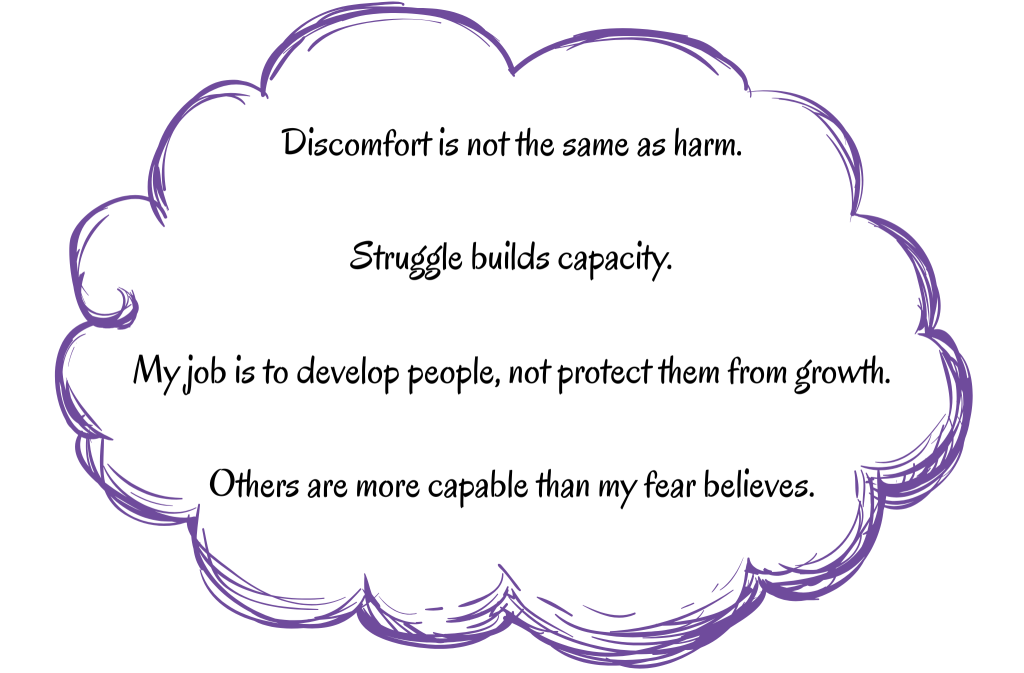
Replace the head trash with grounded truths:

Run micro-experiments to disprove the old wiring:

  • Let someone struggle without rescuing
  • Give direct feedback without softening it
  • Delegate fully—and don’t step back in
  • Pause before absorbing emotional weight that isn’t yours

Each rep weakens the Protector and strengthens trust—both in others and in yourself.

Steps You Can Take This Week

✅ Name your Protector when it shows up
✅ Let someone else own a hard thing
✅ Practice sitting with discomfort instead of fixing it
✅ Ask: “What am I protecting them from—and at what cost?”
✅ Notice where growth requires stretch, not rescue

Leadership grows through trust—not over-functioning.

Moving Beyond the Protector

Moving beyond the Protector doesn’t mean you stop caring. It means you stop confusing care with control and support with sacrifice.

Leaders who upgrade this program:

  • Create resilient, capable teams
  • Regain energy and strategic focus
  • Build cultures of ownership and accountability
  • Lead from trust instead of fear

At Salveo Partners, our Courageous Leadership Program helps leaders identify Faulty Programs like the Protector, dismantle fear-based patterns, and build leadership grounded in trust, resilience, and shared ownership.

What’s Next in This Series

This article concludes our series unpacking the Faulty Programs that keep leaders stuck in the Stuckness Zone™—expending energy on self-protection rather than creating the conditions for people, teams, and organizations to thrive.

While recognizing and upgrading Faulty Programs is a critical first step, it is only one of the many pieces that future-ready leadership requires. In our upcoming Future-Proofing Leadership series, we’ll expand this work by introducing our 3-prong approach to leadership—a practical, research-backed framework designed to help organizations create the foundation leaders need to thrive through ongoing change.

This approach focuses on three essential and interdependent capabilities:

  • Individual Development: Rethinking what it takes to equip people to better lead themselves and others in this age of disruption.

  • Team-Based Courage Building: Key considerations for building and nurturing courageous, high-performing teams.

  • Systems for Sustained Impact: Ensuring critical systems and deliberate practices are in place to reinforce your leadership culture.

Our mission remains simple: Normalize the messiness of being human, expose the invisible patterns holding leaders back, and provide actionable paths to help you and your organization thrive in a disruptive world.

Stay HUMAN. Stay connected. Stay safe. Show Up as a Leader.

Leave a Comment

Your email address will not be published. Required fields are marked *

#1 Individual Development:
The Foundation of Future-Ready Leadership

Leadership development is under greater pressure than ever, yet many organizations still invest in programs that don’t stick.

That’s why Salveo Partners is hosting a new 3-part webinar series for company leaders and HR teams to explore how strengthening leadership across three critical areas can create the conditions for sustainability and greater team and organizational success.

Everyone who registers will receive a link to the recording.

DIGITAL DOWNLOAD

Use this PDF as a visual guide to see how well you are supporting The Fusion of organizational and employee wellbeing and what it takes to have a thriving workplace culture.

This field is for validation purposes and should be left unchanged.
Name
Additional Options

Please fill-up the form to download your file.

We can help you!

Your Name